
The Student Success Academy
In the fall of 2019, 91勛圖厙 began participation in the Higher Learning Commission���s Student Success Academy.泭 The Higher Learning Commission (HLC), 91勛圖厙���s accrediting agency, describes the academies as ���programs aimed at assisting��夷nstitutions to define, develop and implement comprehensive strategies for institutional improvement.���泭 The Student Success Academy specifically is a three year structured project ���designed for institutions seeking to establish sustainable structures that support students��� achievement of their higher education goals.���
The Student Success Academy���s work is designed to relate to and support the institution���s focus on retention, persistence, and completion.泭This work will be completed by the newly formed Student Success Alliance泭in泭泭with 91勛圖厙���s Core Priorities and Board of Trustees ENDS.
The Student Success Alliance
The Student Success Alliance, a newly chartered institutional team, will support the success of students at 91勛圖厙 through the coordination of data-driven processes. Multiple subcommittees within the Alliance will be tasked with specific functions in support of the Student Success Plan: data reviews, data summits, and program review processes. Future tasks or subcommittees will be created based on the support needs of students identified through the Alliance���s ongoing review of clearly defined success metrics. The membership is constructed of faculty, staff, and administration across all campuses of the institution and leadership will be provided by a three-person team representing Instruction, Student Services, and Institutional Effectiveness. The Alliance will meet on the first Thursday of the month at 4 pm. For more information, contact泭StudentSuccessAlliance@bartonccc.edu.
Environmental Scan
The initial phase of the Academy focused on a comprehensive environmental scan consisting of four inventories: The Data Inventory, The Initiatives Inventory, The Infrastructure Inventory, and the Engagement Inventory.泭
Student Success Plan
Data gathered from all four inventories were泭presented in various visual formats泭(color coded lists, charts, etc.)泭in a working ���war room��� to give the Academy Team the opportunity to look for, consider, and discuss connections between the inventory results泭and gaps identified through the inventories in a more holistic way.泭This inductive process allowed the team to triangulate data from multiple initiatives to develop themes for use in the Student Success Plan.
The Student Success Plan泭泭identifies the four themes that emerged following analysis of the environmental scan data.泭 Those themes are data analysis, systematic processes, comprehensive campus support, and holistic care for student populations.泭 The summary also makes recommendations for four actions that, over the next three years, will create the foundation for sustained focus on supporting the success of 91勛圖厙 students going forward.泭 Implementation of these recommendations will move 91勛圖厙 toward the realization of five-year泭.
The Data Inventory
The Data Inventory
The Data Inventory tasked the Academy team with clarifying ���who 91勛圖厙���s students are��� by identifying the student populations served by 91勛圖厙, and to泭 consider the success of the student populations. The inventory sought to identify opportunities to improve data management processes and investigate perceptions of student success at 91勛圖厙.
91勛圖厙���s Data Inventory led the team to the development of a document that is tracking a variety of student demographic information as of each fall, in order to identify potential shifts in the population(s) of students we are serving. Some of this data on our students is presented in the infographics shared below, which will be updated each year.泭
Click on the images below to view the full size info graphics!
泭泭泭泭
The Initiatives Inventory
The Initiatives Inventory
The Initiatives Inventory tasked the Academy Team with exploring ���how the institution is currently serving its various populations.��� Goals included identifying the strategies in place to support student success, and considering if the strategies reflected the institution���s priorities, student populations, and definitions of success.泭 An initiative was defined as ���a targeted strategy, in the form of a program, service, or process, put in place to serve a special population or strategic goal.��� Established, core support functions such as advising and tutoring were not considered to be initiatives for the purpose of this activity.
In addition to identifying initiatives, the Academy Team was asked to gather extensive information about the initiatives, including historical context, goals, populations served, permanency, resources, impact, and accountability.
In the spring of 2020, 91勛圖厙���s Initiatives Inventory led the team create a list of 21 initiatives. The Academy Team asked initiative ���leaders��� or ���owners��� to complete a ten question survey on the initiatives.泭 For a broader consideration of 91勛圖厙���s support of student success, the Academy Team also identified 4 additional integrated activities that support student success but don���t meet the strict definition of an initiative.泭 These additional activities are tutoring, HERO, TRIO/SSS and ACE Math Lab.泭泭
The table below identifies 91勛圖厙���s Student Success Initiatives as identified through the inventory exercise in spring 2020.
|
Cougar Supply Den (Food Pantry) |
Financial Aid Orientation |
Student Emergency Assistance Fund |
泭 Academic Integrity |
|
91勛圖厙 Playbook |
Athletic Mentoring |
Student Academic Development |
泭 Academic Coaching |
|
Summer Bridge |
EMT Tutoring |
Advisor Communications |
泭 Twelve hour letter |
|
Campus Logic |
Second Chance Pell |
Course Review Rubric |
AutoGrad Project |
|
OER |
ADA Compliance |
Bi-weekly grade report |
Student Early Alerts |
|
泭 |
泭 |
Financial Aid Academic Plan Process |
泭 |
Key takeaways from The Initiatives Inventory:
- The need for an identified process for the development, monitoring, evaluation, review, impact, and reporting on status of initiatives.
- None of the initiatives reported ���response to data��� as the pre-curser to development of the initiative.
- A relatively small number of individuals or departments are responsible for many of the initiatives.
- Student participation in initiatives is often passive.
The Infrastructure Inventory
The Infrastructure Inventory
The Infrastructure Inventory posed the question: ���Is it possible that the institution might play a role in the lack of student success?���
This inventory泭began in the泭fall泭of泭2020泭and led the team to request information from campus deans/directors/department leaders regarding current infrastructure, in the form of policies, practices, and/or procedures, that might impact student success.泭Thus, the inventory asked the team to consider what institutional barriers might be serving to impede student success.
Once infrastructure concerns were identified, the team evaluated these for impact and color-coded inhibitors泭to identify which policies had a strong impact泭and泭should receive attention from the institution using tabulation of the following elements:
|
Infrastructure Concern |
Name of the policy or procedure that creates a barrier to student success or area where a policy or procedure could provide support to student success. |
|
Attention needed |
How can the policy/procedure be improved, the potential barrier be reduced or eliminated? |
|
Departmental Ownership |
Which campus department has ownership of the policy (Instruction, Student Services, Enrollment Services, Financial Aid, Academic Development, or Institutional). |
|
Student Goal Affected |
Student Success Goals identified through HLC Student Success Academy, including: Learning, Employability, Satisfaction, Engagement, Retention, Completion, and Goal Attainment. |
Key takeaways from The Infrastructure Inventory:
- A plan for communicating with ���departmental owners��� should be developed.
- A process for tracking progress on addressing the barriers as well as a plan for revisiting the Infrastructure Inventory process on a regular basis should be developed.
- Definition of ���barrier��� should be developed to separate true infrastructure barriers from more minor inconveniences.
The Engagement Inventory
The Engagement Inventory
The Engagement Inventory began in January 2021. The Academy Team hosted泭nine泭focus groups to gather information regarding student, faculty, staff, and administrator perceptions of 91勛圖厙���s commitment to and support of student success泭(four focus groups were held for employees, and five were held for students).泭Focus groups were offered in person and via Zoom for students, and only via Zoom for employees.泭Student and employee representation from all of 91勛圖厙���s campuses participated.泭All focus groups used a combination of survey/poll questions and open-ended questions to gather quantifiable and qualitative data.泭
During泭the student focus groups, the Academy Team asked students about their definitions泭of success, their perceptions of 91勛圖厙���s support of their success, as well as their knowledge of success initiatives and programs offered by 91勛圖厙.泭
During the employee focus groups, the Academy Team walked participants through the HLC student success continuum exercise,泭reviewed 91勛圖厙���s mission泭regarding泭student泭success, and泭gathered responses about individual responsibility for supporting student.
Key takeaways from The Engagement Inventory:
- A positive perspective is clear ��� students feel cared for and employees believe in caring for students.
- Personal relationships and social capital should be continually supported and developed for students.
- Development of the student as a whole is important ��� we do not primarily identify as a specialists in area, career, or subject ��� we develop the human.
- Because needs are so individualized, the recommendation for comprehensive and holistic support becomes important.
- Regular review of 91勛圖厙���s fit within the HLC Student Success Continuum, perhaps as a component of the mission review process moving forward.
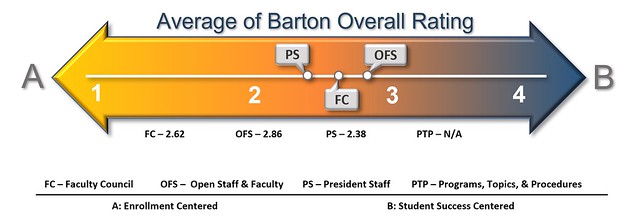
(Expression of Employees' perceptions of 91勛圖厙's placement on the HLC Student Success Continuum)
Data Analysis
Data Analysis
Data gathered from all four inventories were泭presented in various visual formats泭(color coded lists, charts, etc.)泭in a working ���war room��� to give the Academy Team the opportunity to look for, consider, and discuss connections between the inventory results泭and gaps identified through the inventories in a more holistic way.泭This inductive process allowed the team to triangulate data from multiple initiatives to develop themes for use in the Student Success Plan.